Real-Time Speech Analytics: A Clinician's Guide to Piloting Biofeedback
By Howard Henry
Real-time speech analytics pairs live acoustic measurement with instant feedback, giving clinicians and patients moment-to-moment information during a session rather than a summary a week later. The evidence is promising but early: most published biofeedback studies are small pilots, and registered trials such as the AVM-B ambulatory monitoring study (NCT05970562) are still testing whether results hold outside the clinic room.
If your caseload includes stuttering, vocal hyperfunction, or speech sound disorders and you already run telepractice sessions, a small structured pilot is a sensible next step. The practical question is whether your clinic’s workflow can act on the data a platform provides, not whether any single tool suits every caseload.
Key Takeaways
Real-time speech analytics works because it gives clinicians objective, moment-to-moment data that reshapes motor patterns faster than weekly clinic sessions alone can achieve.
| Point | Details |
|---|---|
| Pilot before scaling | Trial with a small, well-defined caseload for 4 weeks before clinic-wide rollout. |
| Track blended metrics | Combine device data (stuttering frequency, tension proxies) with CAPE‑V and V‑RQOL scales. |
| Non-negotiables at procurement | Require clinical evidence, a clinician dashboard, and GDPR-aligned data governance. |
| Select patients carefully | Prioritize motivated, stimulable patients comfortable using ambulatory devices. |
| Flowen as a pilot-ready option | Browser-based speech practice with live microphone-driven visual feedback; clinician tools are available depending on account and configuration. |
Table of Contents
What Is Real-Time Speech Analytics and Why Does It Help Therapy Outcomes?
The core value is simple: clinicians get an objective, moment-to-moment signal they can use to reshape a patient’s motor pattern while it’s happening, not a week later based on memory and impression. Traditional therapy relies heavily on a clinician’s ear and a patient’s self-report between sessions. Real-time analytics closes that gap with continuous measurement.
The systems typically track a handful of signal types:
-
Viseme alignment — how closely a patient’s mouth shape and articulatory movement match a target phoneme, visualized instantly.
-
Phonated-interval monitoring — the duration and consistency of voiced segments, useful for tracking fluency shaping.
-
Laryngeal tension proxies — acoustic markers correlated with vocal hyperfunction, increasingly measurable without invasive sensors.
-
Accelerometer or neck-sensor signals — physical vibration data from the throat that flags strain patterns during natural speech.
Statistic Callout: An Augmented Multisensory Feedback Stimulation (AMFS) protocol produced a significant reduction in stuttering severity following an intensive phase, and that gain held during the reinforcement period that followed.
The mechanism behind this isn’t mysterious. Researchers suggest biofeedback works partly by interrupting overlearned, maladaptive motor patterns, giving the nervous system a chance to build new, more flexible speech strategies instead of defaulting to habit. Immediate feedback reinforces the target pattern at the exact moment it happens, which is when motor learning is most responsive.
In practice, this shows up across three common clinical scenarios: stuttering and disfluency work using phonation-interval training alongside altered auditory feedback, vocal hyperfunction management using ambulatory tension monitoring styled after the AVM‑B approach, and speech sound disorders addressed through visual-acoustic or ultrasound biofeedback. What clinicians actually walk away with are session dashboards, home-practice compliance logs, and epoched summary statistics they can review before the next appointment instead of relying on a patient’s vague recollection of “it felt harder this week.”
Which Feedback Modalities Should Clinicians Know?
Five modality groups cover most of what’s currently available: acoustic analytics, accelerometer or neck-sensor systems, ultrasound visual biofeedback, surface EMG, and altered auditory feedback (AAF/DAF) systems. Each measures something different, and each comes with its own tradeoffs in cost, portability, and training burden.
Ultrasound biofeedback, for instance, lets a patient see real-time tongue movement on screen, which clinicians say helps document “hidden progress” that’s hard to hear but easy to see. A qualitative study of speech-language pathologists using ultrasound found this visualization benefit was consistently valued, but accessibility, equipment cost, and training requirements remain persistent adoption barriers.
Auditory feedback manipulation is more nuanced than it looks on paper. Research on delayed auditory feedback shows that low-latency adjustments can support motor control, while longer delays can actually disrupt fluency rather than help it. Parameter tuning matters as much as the technology itself.
| Modality | Best Clinical Use | Key Limitation |
|---|---|---|
| Acoustic analytics | Tension proxies, telepractice-friendly | Sensitive to background noise |
| Accelerometer/neck sensor | Ambulatory voice monitoring | Requires correct placement |
| Ultrasound visual biofeedback | Speech sound disorders, tongue placement | Cost and training barriers |
| Surface EMG | Muscle-level tension feedback | Clinic-bound, less portable |
| AAF/DAF systems | Fluency shaping, disfluency reduction | Latency must be individually tuned |
Multimodal setups often outperform any single tool. Pairing accelerometer data with acoustic analytics gives clinicians a physical and acoustic cross-check, which matters most in ambulatory monitoring where you can’t watch the patient directly. Modality choice isn’t just a clinical decision, either. It drives procurement cost, staff training time, and the governance structure your clinic needs to support it.
How Do You Build a Clinical Workflow Around Live Feedback?
A minimal trial protocol looks like this: assessment, calibrated baseline, in-session feedback, ambulatory home monitoring, then structured review. That sequence fits neatly inside a standard course of therapy without requiring a clinic to rebuild its entire schedule.
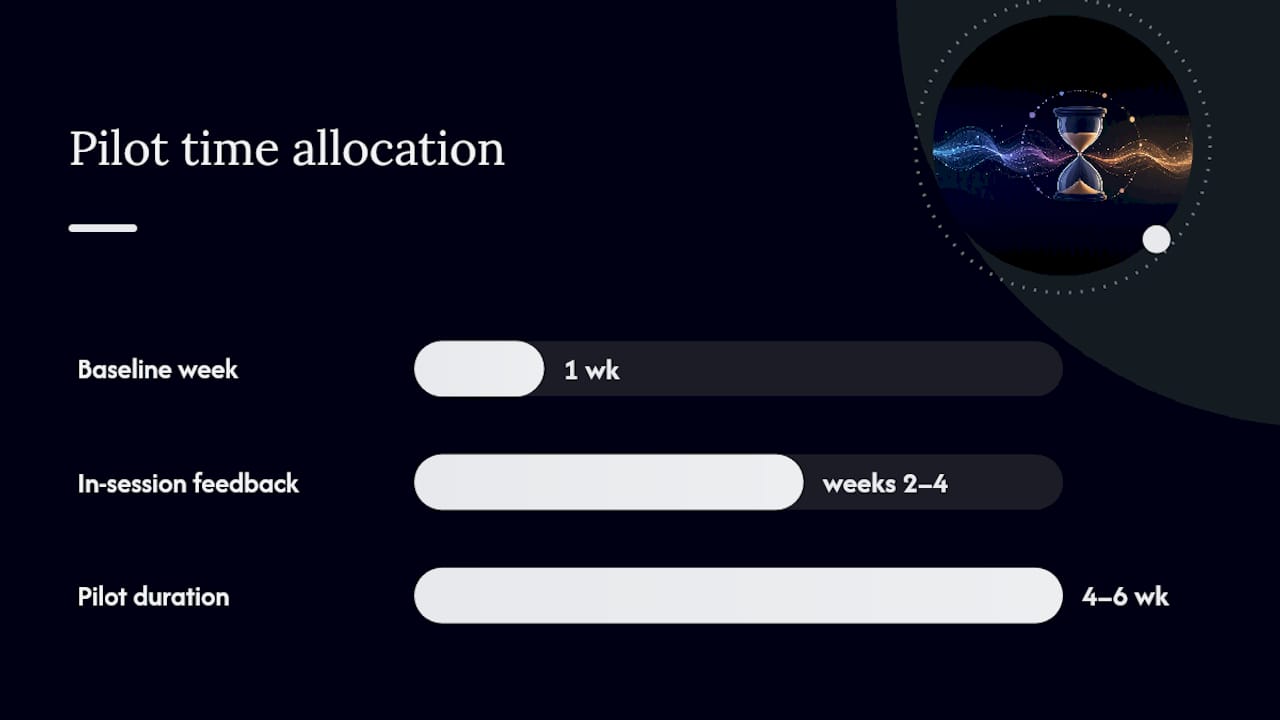
For a four-to-six week pilot, here’s a workflow you can adapt directly:
-
Baseline week — measure stuttering frequency, phonation consistency, or tension proxies without feedback active, to establish a true starting point.
-
Threshold calibration — set individualized alert thresholds based on that baseline, not generic defaults.
-
In-session feedback (weeks 2–4) — introduce live visual or auditory feedback during structured practice, adjusting cues as the patient responds.
-
Ambulatory monitoring — extend tracking into daily life using a portable sensor or app between sessions.
-
Structured review — compare week-over-week dashboard data against baseline at a fixed weekly checkpoint.
Two examples show how this adapts by condition. For a person who stutters, phonation-interval training combined with AAF toggling lets the clinician test which auditory adjustment reduces blocks without introducing new disruption. For vocal hyperfunction, an AVM‑B-style ambulatory protocol tracks percent-accuracy of voiced frames against subject-specific thresholds, exactly as outlined in the registered AVM‑B trial.
Pro Tip: Calibrate thresholds against a patient’s own baseline, not a population average. A generic tension threshold will either miss real strain or trigger constant false alerts, and alarm fatigue kills patient adherence faster than any technical flaw.
Capture session data consistently: frequency counts, tension proxy scores, and compliance logs from home practice. Review weekly during active treatment, then monthly once a patient stabilizes.
What Should Clinics Check Before Procuring a System?
Before signing anything, clinics need evidence of clinical utility, a working clinician dashboard, data protection aligned with UK-equivalent GDPR standards, telepractice integration, and a real training plan. Skip any of these, and adoption stalls regardless of how good the underlying technology is.
A working procurement checklist should cover:
-
Hardware requirements and whether they’re portable or clinic-bound.
-
Interoperability with your existing case management or telepractice software.
-
Per-patient recurring costs versus one-time capital hardware spend.
-
Staff training time and who delivers it.
-
Documentation and clinical governance processes.
-
Defined pilot success criteria before you start, not after.
| Evaluation Area | Non-Negotiable | Why It Matters |
|---|---|---|
| Clinical evidence | Published trial or pilot data | Confirms the tool works beyond marketing claims |
| Data governance | GDPR-aligned storage and access control | Protects patient data and clinic liability |
| Training | Documented competency framework | Prevents misuse and calibration errors |
| Cost model | Transparent per-patient recurring fee | Enables budget forecasting for institutions |
Governance can’t be an afterthought. A proposed framework for ultrasound use by UK speech and language therapists recommends three pillars: defined scope of practice, a competency and training pathway, and formal governance covering data storage and quality assurance. That framework applies just as directly to acoustic and accelerometer-based systems. Score any vendor against these three pillars before committing budget.
Which Outcome Measures Actually Matter?
Track a blended set: device-derived objective measures alongside validated clinical scales. Neither alone tells the full story.
Objective metrics include stuttering frequency counts, phonation-interval consistency, and automated acoustic tension proxies. Validated scales bring in the clinical judgment layer: CAPE‑V for voice quality, V‑RQOL for patient-reported vocal impact, and percent-accuracy of target frames as used in the AVM‑B protocol.
-
Baseline: full battery before any feedback intervention begins.
-
Mid-therapy (week 3-4): device metrics only, quick check for trend direction.
-
End of therapy: full battery repeated for comparison against baseline.
-
Six-month follow-up: full battery again, to check whether gains generalized.
Interpreting change requires some caution. Evidence varies meaningfully by condition, and many of the supporting studies remain small-sample pilots rather than large multi-site trials. Device metrics are proxies, not ground truth. Always triangulate them against perceptual ratings and how the patient actually reports feeling in daily conversation.
Where Does Real-Time Analytics Fall Short?
Live feedback is genuinely useful, but it isn’t a substitute for clinical judgment, and used carelessly it can slow progress rather than speed it. Miscalibrated thresholds are the most common failure point.
Watch for these red flags before and during a pilot:
-
Alert thresholds set from generic defaults rather than the patient’s own baseline, which causes alarm fatigue and disengagement.
-
Vendors offering raw data streams with no clinician dashboard or audit trail.
-
Insufficient staff training on modality-specific setup and interpretation.
-
No documented data governance policy for signal or image storage.
-
Tools presenting data without any clinical interpretation layer.
Patient suitability matters as much as the technology. Motivated patients who are stimulable to the target and comfortable using an ambulatory device tend to benefit most. Contraindications include severe cognitive impairment that prevents safe independent use, and unaccommodated sensory sensitivity that makes constant feedback aversive rather than helpful.
Common technical troubleshooting points worth building into your setup checklist: background noise degrading acoustic analytics accuracy, poor accelerometer placement giving false tension readings, and misaligned viseme models that produce visual feedback that doesn’t match what the patient is actually doing. Each is fixable, but only if staff are trained to spot it early.
Why We Recommend Piloting Small Before Scaling
The honest answer to “should we adopt this” is: pilot with a small, well-defined caseload before you commit to clinic-wide rollout. Institutional adoption tends to hinge less on raw efficacy and more on whether staff feel the tool is manageable inside an already full clinic day.
Three considerations shape whether a pilot succeeds. First, clinician time: expect a real learning curve in the first few weeks, not instant fluency with the dashboard. Second, training investment pays off disproportionately, since a well-trained clinician gets more diagnostic value from the same data than one who’s just clicking through defaults. Third, patient selection drives outcomes more than the technology itself. Choose a cohort with clear stimulability and reasonable comfort with a device, and your pilot data will actually reflect the tool’s potential rather than mismatched expectations.
Flowen’s clinician tools - assignment, session review, programme and messaging interfaces - are permission-based and depend on the account and configuration, and the product orientation page offers introductory material for clinicians and organisations.
How Flowen Fits Into a Real-Time Analytics Pilot
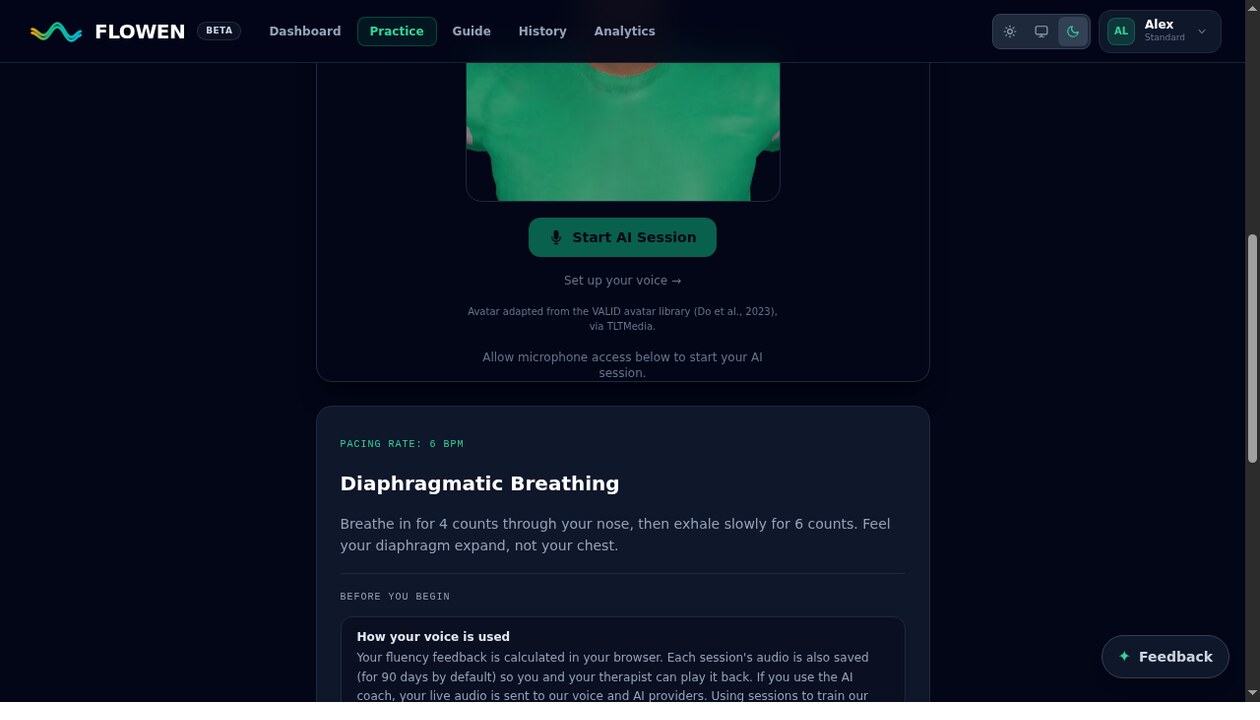
Flowen is a browser-based speech practice platform. Microphone audio drives live visual cues based on acoustic features such as amplitude and pitch, and an avatar demonstration shows animated mouth shapes. These cues support practice; they are not clinical measurements of vocal tension, mouth shape, or a diagnosis. The platform also includes clinician assignment, session review, programme and messaging interfaces, with availability depending on the account and configuration.
On governance: Flowen’s security page describes the mechanisms in the code and their limits. It is not an independent audit, certification or compliance attestation, and DCB0129, DTAC and DSPT sign-off are not claimed. Any clinic evaluating the platform should read that page and the privacy policy as part of its own due diligence.
To explore fit, individual subscription options are listed on the pricing page and organisational access is handled by enquiry. Clinicians can contact the Flowen team through the clinician page to discuss a demonstration, and the waitlist is open for product updates.
Sources
Clinicians consistently report that visualization tools document “hidden progress” patients and families can’t always hear but can clearly see, even when barriers around cost and training remain the biggest obstacle to wider adoption.
This article is general information, not a substitute for advice from a qualified doctor. Consult a qualified healthcare professional about your own circumstances before acting on anything here.