Fluency Shaping vs. Stuttering Modification: Which Fits You?
By Howard Henry
Fluency shaping primarily targets measurable reductions in stuttering frequency by restructuring how speech is physically produced; stuttering modification primarily targets reduced struggle, fear, and improved communication attitudes by teaching you to manage stuttering moments more easily. If your main goal is fewer observable stutters, fluency shaping techniques tend to show stronger short-term frequency reductions. If your main goal is less anxiety, less avoidance, and more natural-sounding speech even when you do stutter, stuttering modification is typically the better fit.
-
Fluency shaping strengths: Measurable reductions in percent syllables stuttered, structured motor learning, clear progression milestones, and strong evidence base for frequency outcomes.
-
Stuttering modification strengths: Reduced struggle and tension during stuttering moments, improved communication attitudes, lower avoidance, and meaningful quality-of-life gains.
Pro Tip: Most people who stutter benefit from asking their speech-language pathologist (SLP) to measure both stuttering frequency and communication attitudes at the start of therapy — that baseline shapes which approach, or blend, fits your goals.
Key Takeaways
Fluency shaping and stuttering modification are both evidence-based approaches, but they target different outcomes, require different practice commitments, and suit different client profiles — choosing between them, or combining them, depends on what you most need to change.
| Point | Details |
|---|---|
| Different primary outcomes | Fluency shaping reduces stuttering frequency; stuttering modification reduces struggle, avoidance, and fear. |
| Evidence supports both | Systematic reviews confirm both are evidence-based, with fluency shaping showing stronger short-term frequency data and stuttering modification showing stronger attitude and avoidance gains. |
| Blended therapy is common | Many clinicians integrate both approaches; the sequence depends on avoidance severity and the client’s primary goals. |
| Practice commitment differs | Fluency shaping requires 30–45 minutes of daily structured practice; stuttering modification requires regular practice plus emotional exposure work. |
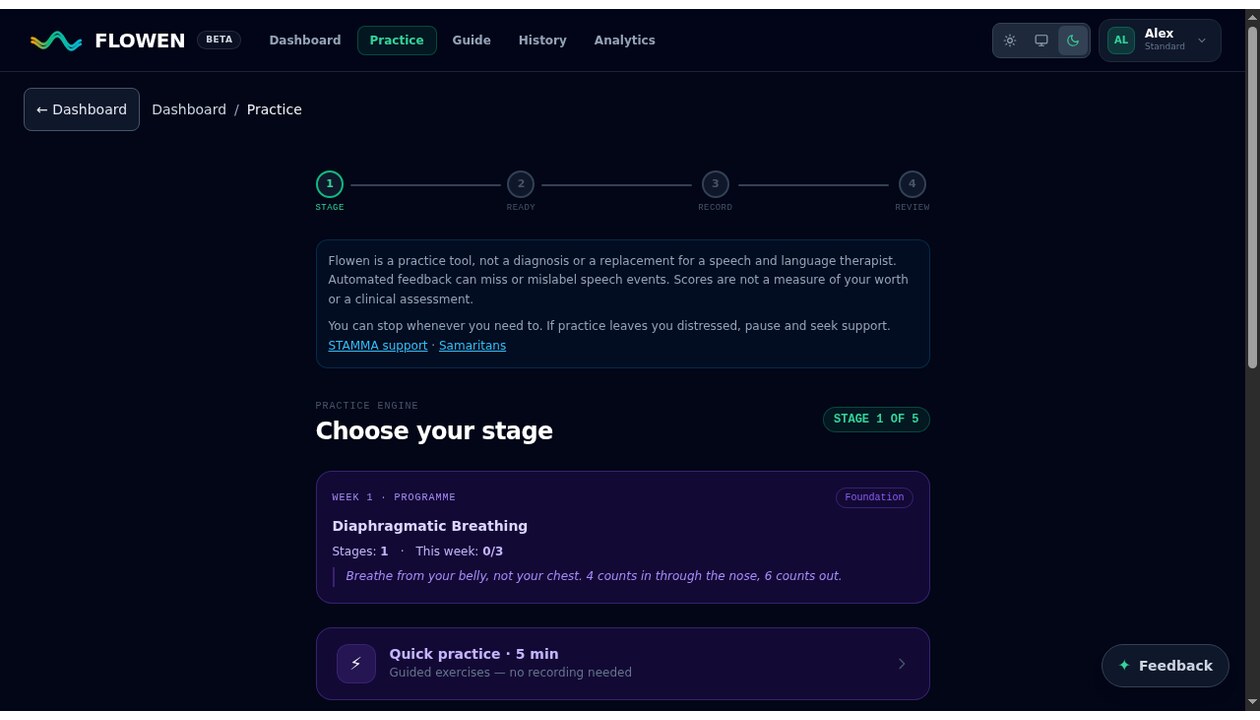
| Flowen supports both | Flowen provides live microphone-based feedback and session history for structured home practice between clinician-led sessions, whichever approach your SLT recommends. |
Table of Contents
-
What is stuttering modification, and what are Van Riper’s phases?
-
Choosing and pacing therapy with your SLT
How do fluency shaping and stuttering modification compare?
The two approaches differ on almost every clinical dimension, from what they measure to how much emotional work they require. The table below maps the dimensions that matter most to people making a therapy decision.
| Dimension | Fluency Shaping | Stuttering Modification |
|---|---|---|
| Primary goal | Reduce observable stuttering frequency | Reduce struggle, fear, and avoidance |
| Core techniques | Prolonged speech, easy onset, gentle contacts, continuous phonation, rate control | Cancellations, pull-outs, preparatory sets, desensitization |
| Best candidate | Adults/adolescents motivated by measurable fluency gains; lower avoidance | People with high avoidance, anxiety, or strong emotional impact of stuttering |
| Practice time | High: daily structured practice (30–45 minutes) with progressive targets | Moderate: regular practice plus emotional exposure work |
| Typical outcomes measured | Percent syllables stuttered, SSI scores | OASES, self-report attitudes, avoidance reduction |
| Key limitation | Naturalness and carryover to daily speech can be challenging | Slower observable frequency reduction; emotionally demanding |
| When combined | FS builds motor foundation; SM adds desensitization and attitude work | SM reduces avoidance first; FS techniques layered in for fluency gains |
Trade-off summary:
-
Fluency shaping delivers clearer short-term frequency data but may not address the cognitive and emotional weight of stuttering.
-
Stuttering modification addresses fear and avoidance directly but typically shows slower reductions in observable stuttering frequency.
-
Neither approach is universally superior; the right fit depends on what you most want to change.
Pro Tip: Ask your SLP which outcome measures they use. If they track only stuttering frequency, they may miss attitude and avoidance changes — and vice versa. A clinician who measures both gives you the clearest picture of progress.
What is fluency shaping, and how does it work?
Fluency shaping is speech restructuring: it teaches you to produce speech differently at the motor level, changing breathing patterns, voice onset, and phonation continuity so that fluent speech becomes the default output. The approach does not directly address stuttering moments; instead, it replaces the speech pattern that produces them.
Core techniques
-
Prolonged speech / continuous phonation: Syllables and words are stretched and connected, reducing the abrupt stops and restarts that trigger blocks. Programs like the Camperdown Program use progressive rate normalization — starting at a very slow, prolonged rate and gradually returning toward natural speaking speed while maintaining fluency.
-
Easy onset: Voice is initiated gently, with a gradual increase in airflow and vocal fold adduction rather than a hard glottal attack. Example: instead of forcing the word “apple” with a tight throat, you let the “a” float in on a soft breath.
-
Gentle contacts / soft articulatory contacts: Lips, tongue, and teeth make light contact with articulatory targets rather than pressing hard. This reduces the physical tension that often precedes a block.
-
Rate control: Deliberate slowing of overall speaking rate gives the motor system more time to execute each movement accurately.
What therapy and home practice look like
A structured fluency-shaping program typically runs 12–20 weeks, with weekly or twice-weekly sessions and substantial daily home practice. Here is a realistic progression:
-
Weeks 1–3: Learn and drill prolonged speech at a slow, controlled rate in single words and short phrases during sessions.
-
Weeks 4–8: Extend techniques to sentences and short conversations; begin daily home practice of 30–45 minutes using structured drills.
-
Weeks 9–14: Transfer techniques to real-world speaking situations (phone calls, work meetings, social conversations) with clinician guidance.
-
Weeks 15–20: Rate normalization — gradually increasing speed while maintaining fluency; self-monitoring and maintenance planning.
The daily practice commitment is real and non-negotiable. In a trial with 20 adults and adolescents who stutter, intensive and spaced fluency-training schedules worked equally well on stuttering frequency, speaking rate and communication attitudes (James et al., 1989). Regular home practice is a standard part of these programs.
Pro Tip: Real-time visual or auditory feedback during home practice can help you notice things your ear alone might miss. A platform like Flowen can provide session-by-session acoustic estimates as an adjunct to your SLT’s programme; these are estimates, not validated outcome measures.

What is stuttering modification, and what are Van Riper’s phases?
Stuttering modification focuses on reducing the struggle, tension, and fear associated with stuttering moments rather than eliminating stuttering itself. The goal is to stutter more easily, with less physical effort and less emotional cost. Van Riper’s four-phase model remains the standard clinical framework for organizing this work.
The four phases
-
Identification: You and your clinician catalog your stuttering patterns in detail — where blocks occur, what physical behaviors accompany them (eye blinks, head movements, lip tension), and what avoidance strategies you use (word substitution, circumlocution, silence). Awareness precedes change.
-
Desensitization: Systematic, graduated exposure to feared words, sounds, and speaking situations reduces the emotional charge they carry. This phase often involves voluntary stuttering — deliberately producing mild stutters in low-stakes situations to reduce shame and fear.
-
Modification: Three core techniques are introduced and practiced:
-
Cancellation: After a stuttering moment ends, you pause, then repeat the word using a smoother, less tense production. This builds awareness and control after the fact.
-
Pull-out: During an active block, you slow down, reduce tension, and ease out of the stutter rather than forcing through it. This is practiced in real time.
-
Preparatory set: Before a feared word, you mentally prepare a relaxed, easy approach — planning the onset before speaking. This is the most advanced technique and requires prior mastery of cancellations and pull-outs.
-
-
Stabilization: Techniques are consolidated across all speaking situations, emotional work is reviewed, and a long-term maintenance plan is built. Relapse prevention is addressed explicitly.
Session structure and emotional work
Sessions in stuttering modification are less drill-focused than fluency shaping and more conversational. Clinicians pace exposure carefully — moving to more challenging situations only when the emotional response to easier ones has genuinely reduced. Homework involves real-world speaking assignments: making a phone call, introducing yourself to a stranger, or using a feared word deliberately in a conversation.
-
Practice is regular but less time-intensive than fluency shaping (typically 15–30 minutes of structured daily work).
-
Emotional processing is built into the therapy, not added as an afterthought.
-
Progress is measured through attitude scales (such as the OASES) and self-report, not just frequency counts.
Pro Tip: Clinicians experienced in stuttering modification pace exposure deliberately — moving too fast through desensitization triggers avoidance rather than reducing it. If a homework assignment feels impossible rather than just uncomfortable, tell your SLP. Adjusting the difficulty gradient is part of good clinical practice, not a sign of failure.
What does the research say about outcomes?
Both approaches are evidence-based, but they target different outcomes and the research reflects that clearly. A 2020 systematic review of interventions for adults who stutter (Brignell et al., Journal of Fluency Disorders) found the strongest controlled evidence for speech-restructuring approaches such as fluency shaping: across the included adult trials, stuttering frequency fell by about half on average, with follow-up periods generally short. ASHA treatment guidance frames stuttering-modification goals around reducing avoidance and the impact of stuttering on participation and quality of life, not frequency counts alone.
Stuttering modification programs have demonstrated meaningful reductions in affective and cognitive impacts on stuttering, with clinical trials showing behavioral and attitude improvements over months in participants enrolled in extended modification-based programs. The same review notes that speech-restructuring approaches have the largest body of controlled trial evidence, while reporting that the degree and maintenance of fluency gains varied across studies. Neither approach shows uniform lasting success (Prins & Ingham, 2009).
Limitations of the current evidence
-
Most trials use small samples and short follow-up periods, making long-term maintenance data limited.
-
Outcome measures differ across studies (frequency counts vs. attitude scales), making direct comparisons difficult.
-
Heterogeneity in how each approach is delivered means “fluency shaping” in one study may look different from another.
-
Few studies directly compare the two approaches head-to-head in the same population.
The practical implication: if you value measurable, trackable reductions in stuttering frequency, fluency shaping has a stronger evidence trail for that specific outcome. If you value reduced fear, less avoidance, and improved quality of life, stuttering modification has a stronger evidence trail for those outcomes. Neither approach has a monopoly on long-term success.
How do you choose between the two approaches?
Prioritize the therapy that aligns with your primary goal and that includes a clear plan for long-term maintenance. That single principle cuts through most of the confusion.
Questions to ask your SLP at intake
-
What outcome measures do you use, and how often will we track them?
-
Do you use behavioral measures (percent syllables stuttered, SSI) or attitude measures (OASES), or both?
-
What does a typical homework assignment look like, and how much daily practice will I need?
-
How do you address avoidance and anxiety if they are present?
-
Do you offer teletherapy or remote monitoring for home practice?
-
What is your plan for maintenance after the active therapy phase ends?
-
How do you adjust the program if I am not progressing as expected?
Red flags to watch for
-
A clinician who promises a permanent “cure” for stuttering.
-
No measurement of stuttering frequency or communication attitudes at baseline.
-
No maintenance plan discussed before or during therapy.
-
Emotional work is entirely absent when avoidance or anxiety is clearly present.
-
Homework is never reviewed or adjusted based on your progress.
Timeline and cost considerations
Fluency shaping programs typically run several months of active therapy, with ongoing maintenance practice afterward. Stuttering modification programs often run multiple months given the depth of emotional work involved. Costs vary widely by setting: NHS-funded speech and language therapy in the UK may cover either approach, though waiting times and program availability differ by region. Private SLP sessions typically range from moderate hourly rates, with total program costs depending on session frequency and duration. Insurance coverage in other markets varies by plan and diagnosis code; always confirm coverage before committing to a program.
When do clinicians combine both approaches?
Many clinicians integrate fluency shaping and stuttering modification because stuttering has motor, cognitive, and emotional components that no single approach fully addresses. Recent reviews support this integrated model, describing blended programs as individualized plans that combine motor learning strategies with cognitive-behavioral elements.
Common hybrid treatment sequences
Sequence A — Fluency foundation first: Begin with fluency shaping to establish motor control and reduce observable stuttering frequency. Once the client has reliable technique use, introduce stuttering modification’s desensitization and pull-out work to address residual avoidance and anxiety. This sequence suits people with moderate stuttering severity and lower initial avoidance.
Sequence B — Modification first for high avoidance: When avoidance and anxiety are severe, starting with fluency shaping drills can feel overwhelming and may increase pressure. Begin with identification and desensitization phases of stuttering modification to reduce emotional reactivity, then layer in fluency shaping techniques as the client becomes more comfortable with stuttering openly.
Sequence C — Parallel integration: Some clinicians run both tracks simultaneously from the start, using fluency shaping techniques in structured drills and stuttering modification techniques in conversational practice. This requires a highly experienced clinician and a client who can manage two skill sets at once.
| Hybrid sequence | Best suited for | Maintenance approach |
|---|---|---|
| FS foundation → SM desensitization | Moderate severity, lower avoidance | FS self-monitoring + SM relapse tools |
| SM first → FS layered in | High avoidance, significant anxiety | Ongoing attitude tracking + FS drills |
| Parallel integration | Motivated adults, experienced clinician | Combined frequency and attitude measures |
Who benefits most from a blended plan:
-
People whose stuttering has both high frequency and high emotional impact.
-
Adolescents and adults who have tried one approach alone without full satisfaction.
-
Anyone whose avoidance behaviors are actively limiting daily communication.
-
Clients who want both measurable frequency data and quality-of-life improvement tracked simultaneously.
How can digital biofeedback support both approaches?
Digital biofeedback can accelerate motor learning for fluency shaping and provide objective practice-tracking data that supports stuttering modification goals. Real-time acoustic telemetry — the kind that measures voice onset timing, phonation continuity, and laryngeal tension — gives both you and your clinician objective data that subjective self-report cannot match.
For fluency shaping, the practical use cases are direct: guided home practice for easy-onset drills, real-time visual feedback on continuous phonation, and session-by-session data that shows whether technique use is improving or plateauing. For stuttering modification, the value is different but equally real: objective tracking of practice fidelity, measurable data to share with your clinician between sessions, and a structured environment for graduated exposure practice.

Flowen is a browser-based practice platform: microphone audio drives live visual cues through an animated avatar, alongside guided exercises and session history. Assigned clinician accounts can review their clients’ session activity between appointments, with access permission-based and dependent on the account and configuration. Flowen does not diagnose, treat or cure stammering, and its automated readings are practice estimates, not clinical measurements.
Practical use cases for digital biofeedback:
-
Home practice for easy-onset and prolonged speech with immediate acoustic feedback.
-
Remote monitoring of practice fidelity by a supervising SLP between sessions.
-
Objective progress tracking to share with clinicians, commissioners, or insurance providers.
-
Graduated exposure practice in a private, low-pressure environment as part of desensitization work.
Limitations to keep in mind: Digital tools are adjuncts to clinician-led therapy, not replacements. The emotional work of stuttering modification — desensitization, acceptance, identity work — requires a trained clinician. Biofeedback platforms support practice and measurement; they do not substitute for the therapeutic relationship or clinical judgment. Clinician oversight is recommended for any structured biofeedback program.
Pro Tip: If your SLP offers remote monitoring through a biofeedback platform, use it consistently. Clinicians who can review your between-session practice data can adjust your program far more precisely than those working from weekly self-report alone.
Choosing and pacing therapy with your SLT
It can be tempting to choose an approach based on what sounds most appealing rather than what your actual goals require. Fluency shaping sounds reassuring because it promises measurable progress. Stuttering modification sounds daunting because it asks you to lean into the stutter rather than away from it. Neither impression is wrong, but neither is the whole picture.
Assessment guidance from the American Speech-Language-Hearing Association covers both sides of stuttering: how often it occurs, including the tension and avoidance behaviours around it, and its impact on your communication, confidence and quality of life. Those two together shape where therapy starts, and treatment goals can include both reducing struggle and avoidance and reducing negative emotional responses such as anxiety. Tell your SLT what matters most to you; the plan should reflect it.
A practical checklist for your first 4–8 weeks of therapy:
-
Confirm that your SLP has measured both stuttering frequency and communication attitudes at baseline.
-
Identify your top two or three speaking situations where stuttering most limits you.
-
Agree on what “progress” means in measurable terms before the fourth session.
-
Complete every homework assignment, even imperfectly — consistency matters more than perfection.
-
Report emotional resistance or avoidance to your SLP immediately; it is clinical information, not a personal failure.
-
Ask for a maintenance plan discussion by week six, even if active therapy is ongoing.
Pacing matters as much as technique selection. Ask your SLT how they will adjust the plan if progress stalls, or if the emotional side of the work feels harder than expected. A good plan responds to what your data and your experience are actually showing, not what a protocol assumes.
Flowen as an adjunct to your speech therapy program
Real progress in speech therapy depends on what happens between sessions, not just during them. Flowen is a clinician-supported neural biofeedback platform built specifically to extend the reach of your SLP’s program into your daily practice routine.
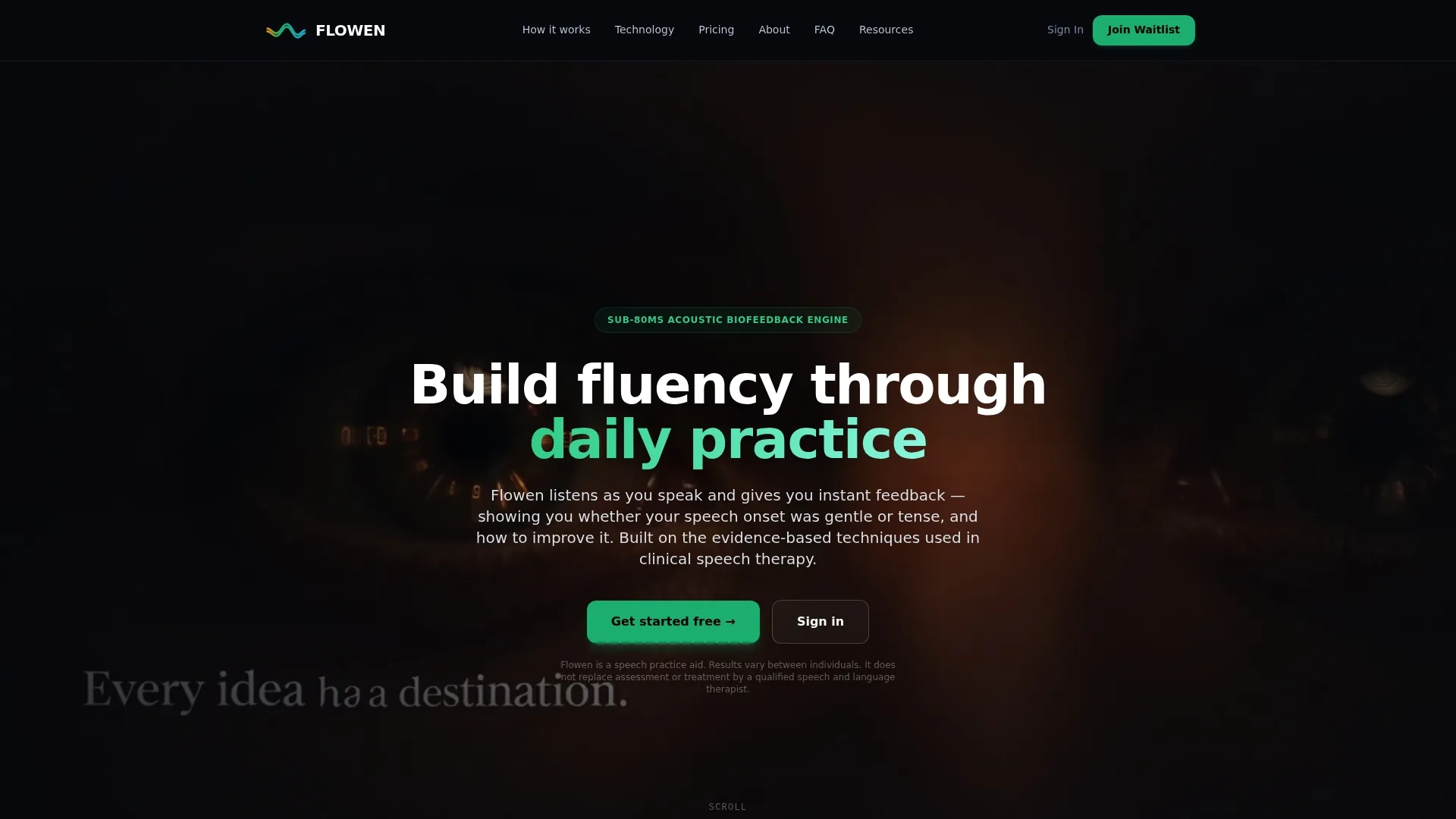
Flowen gives you live visual feedback driven by your microphone audio, based on acoustic features such as amplitude and pitch, through an animated avatar, plus guided exercises and session history you can review over time. The readings are practice estimates, not clinical measurements, and Flowen does not diagnose, treat or cure stammering. If a clinician supports your therapy, assigned clinician accounts can review your session activity with the right permissions. Individual subscription options are on the pricing page, organisational access is by enquiry, and the waitlist is open for product updates.
Sources
This article is general information, not a substitute for advice from a qualified doctor. Consult a qualified healthcare professional about your own circumstances before acting on anything here.